Eddie
On the RoadEddie is a hitchhiker and former post-office truck driver who joins Sal Paradise during Sal’s 1947 journey west. His episode begins with an impulsive offer of company beneath an elm tree in Iowa and ends, in the evidence available here, with his unsuccessful attempt to settle into work in Denver. Along the way, Eddie’s cheerfulness, drinking, absent-mindedness, and reliance on Sal turn a chance meeting into a small but telling study of fellowship and vulnerability on the road.
Identity and Introduction
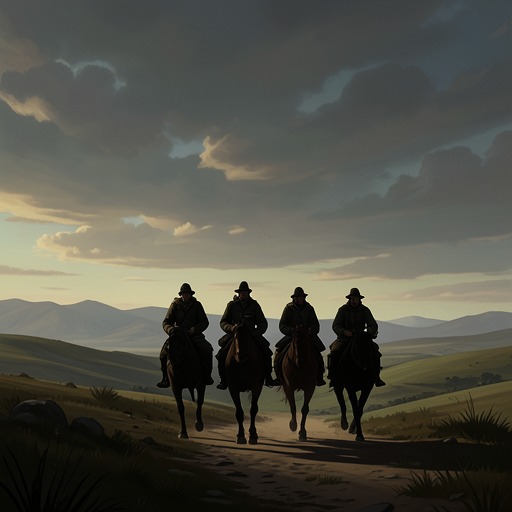
Sal meets Eddie in Adel, Iowa, after rides with a tool salesman and a farmer and his son. Eddie is an Irishman from New York, about thirty, who says he is heading to a girl in Denver and a new life. Sal suspects he may be escaping something back east, perhaps trouble with the law, but this remains Sal’s impression rather than established fact. Eddie has spent most of his working years driving a truck for the post office; on the road he has no bag, only a toothbrush and handkerchiefs, and wears a worn sweater and baggy pants.
Eddie does not enter the story as an obviously dependable traveler. Sal thinks he looks so rough that he should have declined the suggestion that they hitch together. Yet Sal’s own alertness to human companionship outweighs that reservation. Eddie’s shabby appearance and scant belongings make his need for company visible, while his willingness to propose traveling together gives the encounter its forward motion.
The Road Through Iowa and Nebraska
After a quiet driver takes them to Stuart, the two men wait for westbound traffic for about five hours outside the railroad-ticket office. Their conversation dwindles from accounts of themselves to Eddie’s dirty stories, then to kicking pebbles and making foolish noises. Sal spends a dollar on beer; Eddie drinks heavily and talks excitedly about the sordid dreams of his life. Sal says he likes Eddie not because he has proved himself a good sort, but because he is enthusiastic. The distinction captures their provisional bond: affection forms before trust has been tested.
They return to the road in darkness and wait until three in the morning. They try to sleep on a bench, but the telegraph clicks and freight trains clatter outside. Neither knows how to board a freight train or how to determine its direction, so when an Omaha bus arrives before dawn, Sal pays both fares. Eddie reminds him of a cousin-in-law from the Bronx, a resemblance that helps explain why Sal keeps him close: for the moment, Eddie feels like an old friend, smiling and good-natured, with whom Sal can simply goof along.
Their progress depends on uncertain exchanges rather than a steady plan. After reaching Omaha, they hitch rides again, including one with a rancher who praises the Platte Valley. A cowboy later asks whether either man can drive two cars back to Montana; Eddie has a license and can drive, unlike Sal. At another point, a carnival proprietor offers them beds but no food and invites them to join the enterprise. They decline because Sal is in a hurry to reach Denver. The episode gives the journey a briefly imagined alternative: instead of continuing west, the pair might have spent nights on the plains in a carnival wagon, among Ferris wheels and traveling families.
Separation and Reunion in Denver
In Shelton, Nebraska, an old man in a strange homemade aluminum trailer stops and says he can take only one passenger. Eddie jumps in without a word and rattles away, wearing Sal’s wool plaid shirt. Sal loses both his companion and the shirt, which he describes as sentimental rather than materially valuable. The separation is abrupt and almost absurd: their partnership has depended on shared rides and goodwill, and it can be broken by a stranger’s single seat.
Sal waits several hours in Shelton, thinking dusk has arrived when it is only early afternoon, before another driver takes him toward Denver. Eddie later calls Sal after reaching the city and remembering names Sal had mentioned. He is staying with his girl in a house off Colfax and asks whether Sal knows where he might find work. Sal invites him over, hoping Dean Moriarty will know. The call reverses the earlier separation: the road companion who vanished in a trailer has found his way back into Sal’s life through remembered names and a telephone.
Work, Generosity, and Limits
Sal, Eddie, and Dean Moriarty go by trolley across Denver to look for jobs. A man in the markets agrees to hire both Sal and Eddie, with work running from four in the morning until six in the evening. Eddie readily accepts, saying the employer has found his man; Sal is already unsure that he will keep the schedule, since he does not want to give up the city’s other attractions in order to sleep. The contrast foreshadows the unequal outcome: Eddie appears prepared to work, while Sal remains drawn toward the social life around him.
Eddie shows up the next morning, but Sal does not. The available account does not say whether Eddie keeps the job. Instead, it shows the travelers’ paths diverging again: Sal has a bed with Roland Major, who buys food for the icebox in exchange for Sal cooking and washing dishes, and Sal becomes absorbed in Denver’s parties and friendships. Eddie’s practical effort to find employment is thus set against Sal’s reluctance to submit to routine, even as Sal has been the one to pay Eddie’s bus fare and help him reconnect in town.
Narrative Role
Eddie’s appearances give the long westward journey a recurring human scale. The landscapes and routes open out from Iowa toward Denver, but movement is always mediated by specific arrangements: a farmer’s ride, a night at a ticket office, a bus fare paid by Sal, a driver who can take only one passenger, and a job with a punishingly early start. Eddie participates in this improvised economy as both recipient and companion. His license makes him useful on the road; his lack of luggage, drinking, and dependence on Sal make him vulnerable within it.
The episode does not turn Eddie into a lasting member of Sal’s Denver circle or settle what becomes of him after the first workday. Its quieter significance lies in the gap between attachment and permanence. Sal’s instinctive kindness gives a stranger temporary shelter in the journey, but the road keeps separating people as easily as it brings them together. Eddie’s repeated arrival and disappearance make that instability concrete without reducing their companionship to mere convenience: Sal chooses his company because, amid uncertain rides and lonely waits, Eddie is enthusiastic and familiar enough to feel like a friend.